In 1923, World War I had recently ended, women had won the right to vote, prohibition was in full swing, and Model T cars had only been around for ten years. The Great Depression was still seven years away. And polio was an epidemic.
Some with polio returned home after a brief stay in the hospital. But many suffered paralysis, and had difficulty swallowing and breathing. Physical therapy was the only hope for patients who wanted to learn to walk again after suffering this debilitating illness. Because it was so contagious, children with polio were quarantined and not allowed to be around any other children, including their siblings. At the time, most facilities who were willing to care for polio victims were sterile wards with beds lined up in a row. There was no play, there was no reading, there was no learning, there was no childhood for someone with polio.
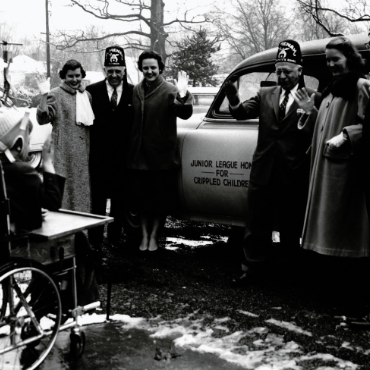
In response to the polio epidemic of the 1920’s, the Junior League created its first community placement: working in the Junior League Home for Crippled Children. Originally a nine-bed facility, the Junior League Home was located at 9th and Monroe, a location which was provided rent-free through a gift from the Standard Oil Company. There were other institutions available for children suffering from polio, but they were just that: institutions. The Junior League Home was the only one that had a warm, “home-like” atmosphere. League members did a wide variety of volunteer jobs, ranging from reading to the children, feeding those who had difficulty feeding themselves, helping with hygiene, making home-cooked meals (which often had to adhere to strict dietary restrictions), making clothing, and gardening. Most of the children served then were between the ages of six and ten, but there were some as young as six weeks and some as old as sixteen. For many, the Junior League Home was the first time they had ever been away from their own home. The care of the children was completely paid for by Junior League funds.
By 1930, the need for more care for those stricken with polio had increased, so the Junior League raised enough money to purchase a larger Home on White Avenue. The annual Palm Sunday Paper Sale was an incredibly successful fundraiser for the League. Funds raised from it enabled the new Home to be equipped with an outpatient clinic, a schoolroom, a therapy room, a dental department, and even a station wagon! By 1941, the League’s fundraising success, along with several bequests, resulted in surplus funds. Some visionary Junior League members had the wisdom to use the extra money to establish a Trust Fund for the benefit of the patients in the Junior League Home.
In 1954, Jonas Salk discovered a vaccine for polio and the numbers of cases began to decline. At the same time, the Junior League made the decision to accept and treat children who were medically crippled as well as those who were orthopedically crippled. This meant the Home now had patients with conditions such as cerebral palsy, burns, kidney disease, and congenital heart defects, and even victims of child abuse in addition to those with orthopedic concerns.
Since the move into the Children’s Hospital in 1970, the Junior League and Vanderbilt Children’s Hospital have continued to work together to provide the best possible care to children of Middle Tennessee and surrounding areas. The Junior League has provided volunteer support over the years as well as play equipment and actual “bricks and mortar.” Because of the wisdom of some Junior League members back in 1941 and thanks to the prudent advice of our Trustees over the years, the Trust fund has increased to over $8 million. The funds are earmarked for the “crippled child,” so the League has used those monies to initiate several programs in the Hospital: in 1984, the Junior League Children’s Lung Center was founded with a JLN gift of $500,000; in 1992, the League gave $750,000 for the Junior League Center for Chronic Illnesses and Disabilities of Children (now known as the Junior League Family Resource Center); most recently, the League has donated gifts of $2 million to build the new, freestanding Monroe Carell, Jr. Children’s Hospital at Vanderbilt and $500,000 to fund the building of the Junior League Eating Disorders Center.
The Junior League of Nashville is steeped in the tradition of giving to those around us, especially to children who are in need. Since 1970, the Junior League has been privileged to partner with one of the finest Children’s Hospitals in the nation. May our Home continue to serve in the future as well as it has always served in the past!